Jump to Section
- What Makes Spouse Caregiver Burnout Different
- Warning Signs
- What Burnout Does to Your Body
- The Emotional Weight No One Talks About
- Steps You Can Take Right Now
- Support in Northeast Arkansas
When Loving Someone Means Losing Yourself
You're probably reading this on a stolen fifteen minutes, or at the end of a day that didn't end the way it was supposed to. Maybe you've been telling yourself you're fine, or almost fine, or fine enough. What's harder to shake is the feeling underneath that, the one that made you start looking around in the first place.
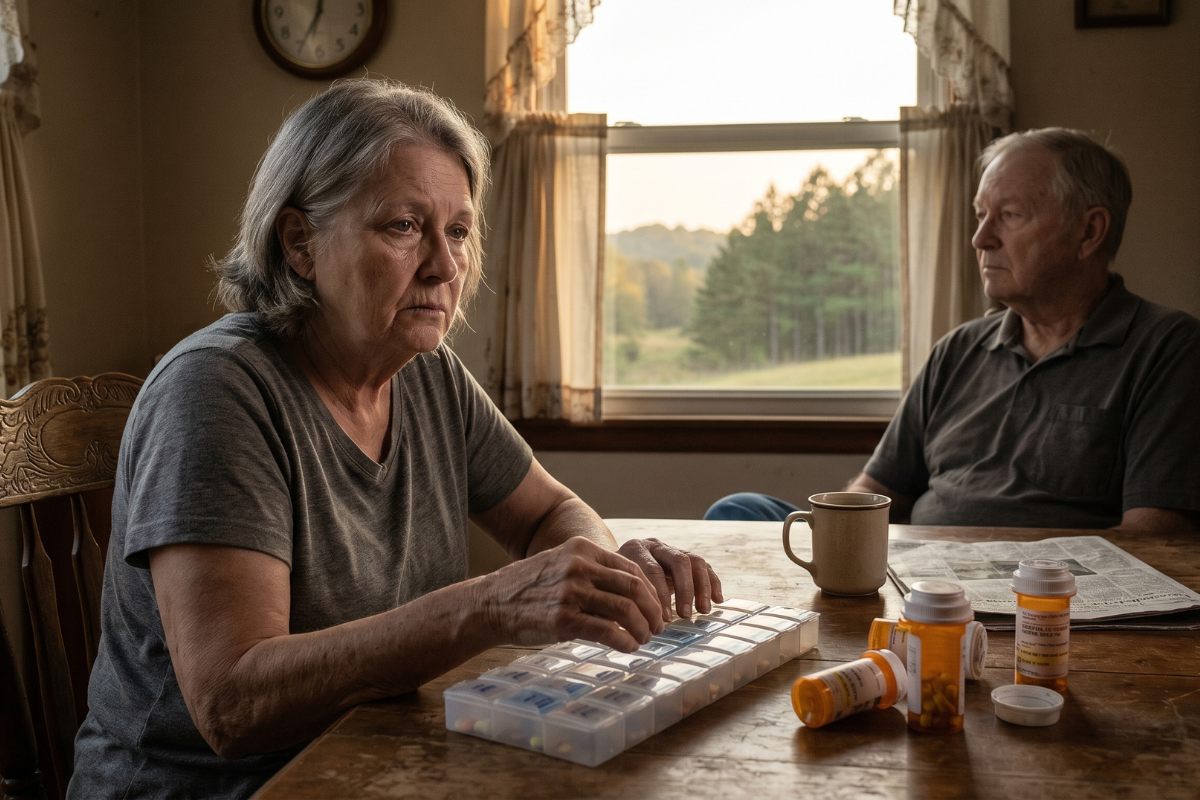
Nobody sits down at a kitchen table and plans for this. You made a vow, and you're honoring it. Some mornings that looks like managing a pill organizer at 6 a.m. Other mornings it's sitting in a waiting room for the third time this week, running tomorrow's list in your head while today isn't even done. At some point, a question starts following you around: is it supposed to feel this hard?
What you're feeling has a name: caregiver burnout. It shows up differently when the person you're caring for is your spouse, partly because the grief and the love and the exhaustion are all tangled together in a way that's hard to separate out. This article is for people who are already in it and haven't quite admitted that yet. You don't need to have a plan or be ready to ask for help. You just need to know what's here in Northeast Arkansas, and that you're not the only one who's been standing where you're standing right now.
What most people can't quite bring themselves to say is that caring for a spouse isn't like caring for a parent or a sibling. You didn't step into this knowing it was a possibility someday. You're watching the person you chose, the one your whole life is built around, need you in ways neither of you ever pictured. What that does to a marriage, to your sense of the future, to your sense of yourself: that doesn't have a clean name. And somehow you're just supposed to keep going.
People who haven't done it tend to think of caregiving as a set of tasks. Appointments, medications, meals. They don't see the other part.
What Makes Spouse Caregiver Burnout Different
You've probably seen articles about caregiver burnout. We've covered early signs of caregiver burnout ourselves. But spouse caregiver burnout sits in a category by itself, because what you're losing isn't just time or energy. You're losing the equal partnership that made your marriage yours.
It sneaks up on you that way. One day you're both navigating life together, and somewhere along the way you realize you're the only one navigating. The person who used to weigh in on decisions, cover the things you hated doing, talk you off the ledge at 10 p.m. is still there, still loved. But that back-and-forth is gone. You're holding both ends of the rope now, and most people around you haven't even noticed.
There's also the grief that doesn't have a name yet. Anticipatory grief is what happens when you mourn someone while they're still alive. If your spouse has dementia, Parkinson's, or another progressive condition, you may have already lost versions of them along the way: the version who remembered your anniversary, the one who drove, the one who made you laugh in a specific way only they could. That grief is real, even if no one around you treats it that way.
Then there's the guilt that keeps you from asking for help. Adult children in caregiving situations can, at some point, step back. They can hire help, take a break, make a call. Spouses rarely feel that option is open to them. The sense that leaving, even for an afternoon, means abandoning your partner keeps a lot of people isolated long past the point where they needed support.
Something else gets worn down too, quietly, over time. You stop being able to say what you want for dinner, let alone what you want from life. When the give-and-take of your partnership disappears, so does the version of you that existed inside it. A lot of spousal caregivers describe this as feeling like a stranger in their own life, not depressed exactly, just a little gone.
By the time burnout settles in, most people don't recognize it for what it is. Here's what it tends to look like.
Warning Signs
Spouse caregiver burnout tends to sneak up on you. You don't notice it arriving. You just notice, one day, that you're tired in a way that isn't fixed by sleep, that you can't remember the last time you looked forward to something, that the days feel like they're happening to you rather than something you're living.
One of the most telling signs is exhaustion that sleep doesn't fix. You go to bed tired, and you wake up tired. Rest stops feeling like rest.
You might catch yourself having a thought you'd never say out loud. Something angry, or dark, or just honest in a way that feels shameful. And then instead of the thought passing, you carry the guilt about it for the rest of the day. That loop, the thought and then the punishment for thinking it, is worth paying attention to. It usually means you're running on empty and haven't had a real outlet in a long time.
Other signs are easier to overlook. You've stopped seeing friends. You've dropped the hobbies and activities that used to matter to you. You're skipping your own doctor appointments, not eating well, not moving your body the way you used to. Your own health has quietly moved to the bottom of the list.
There are days where you go through every task, get everything done, and feel nothing. Not relief, not love, not even frustration. Just a blankness. People sometimes mistake that for having adjusted or gotten used to it. It isn't that. When you've been running on empty for long enough, that numbness is what running on empty actually looks like. It's not peace. It's your body and your mind quietly telling you they've been at it too long without a break.
What you're experiencing might also be compassion fatigue, a related but distinct experience that can develop when you've spent a long time absorbing someone else's pain.
Burnout doesn't stay in your head. It gets into your body.
What Burnout Does to Your Body
Spousal caregiver burnout isn't something you notice in real time. It accumulates quietly, showing up first as fatigue you chalk up to a bad week, then as a stiffness in your shoulders that won't quit, then as something harder to name. Most caregivers don't connect those dots until their body stops cooperating.
According to the Family Caregiver Alliance, spousal caregivers who are 65 and older have a 63% higher mortality rate than non-caregiving peers of the same age. Spouses caring for an ill or disabled partner are nearly 6 times more likely to experience depression or anxiety symptoms. Those aren't small numbers.
A 2024 CDC analysis found that 13 of 19 health indicators were worse for caregivers compared to non-caregivers, including depression rates, which rose over the course of the study period. What stands out about that finding isn't any single number, it's the breadth. Nearly every measure they tracked moved in the same direction, and it didn't matter how old the caregiver was or how long they had been doing it. The pattern held across the board.
Per a 2023 AARP survey, more than 60% of caregivers say caregiving has increased their stress level. Four in 10 caregivers (39%) report they rarely or never feel relaxed.
The research keeps pointing to the same uncomfortable truth: spousal caregivers put their own health at the bottom of the list. Not out of carelessness, but because there's always something more pressing right in front of them. A prescription to pick up. A follow-up appointment. A rough night that ran long. You keep telling yourself you'll deal with it later, and then later turns into a year, then two, and the damage accumulates whether you've been watching for it or not.
The practical reality of caregiving crowds out your own health in ways that feel minor in the moment. Say you've had a symptom nagging at you for three weeks. Nothing dramatic, just something off. But there's an appointment to get your partner to on Thursday, and then the weekend is complicated, and calling your own doctor keeps landing at the bottom of a list that never gets shorter. That's not a failure of willpower. That's what happens when your body isn't being taken care of while it's doing the caring.
Those numbers from the CDC aren't describing some abstract group of caregivers in a study. They're describing what happens to people in situations like yours. That's worth sitting with, because recognizing the pattern is usually what it takes before someone finally calls their own doctor.
The studies measure depression rates and mortality risk because those are things you can count. What they can't fully capture is the specific weight of being the one person in the household who simply cannot be unavailable. Not sick, not exhausted past functioning, not out of commission for a day. Other kinds of stress have some give to them. This kind doesn't, and that constancy is its own category of hard.
The Emotional Weight No One Talks About
When a spouse becomes someone you care for, the loss doesn't announce itself. There's no moment most people around you will recognize. Nobody brings a casserole. Nobody sends flowers. But something real is gone, and it keeps being gone, day after day, in ways that don't fit any of the rituals we have for grief.
Most grief makes itself known. This kind settles in quietly. You're standing at the sink or sitting in a parking lot when it hits you: the life you'd planned together isn't the life you're living. It didn't disappear all at once. It went piece by piece, over months and years. The person who knew your whole story without needing the backstory. The relationship that existed before pill organizers and doctor's notes moved in and took over. That loss is real, and it doesn't stop happening, and most people around you won't have a name for it. There is actually a clinical term: ambiguous loss. You're grieving someone who's still sitting across the table from you.
That particular hurt is one of the most overlooked pieces of spouse caregiver burnout. Because it doesn't look like the grief people recognize, it usually just gets swallowed.
The isolation can compound all of this. When caregiving takes over, shared friendships tend to fade. The couples you used to see, the friends who knew you as a pair, start to feel distant. It's hard to explain what your life is like now to people who haven't lived it. That particular loneliness is something we've explored in our piece on loneliness in caregivers, and it affects spousal caregivers in ways that are distinct from other caregiving relationships.
Think about the small things that made up your marriage. Decisions you worked through together. The tasks your spouse handled so automatically you never had to think about them. Now those things are yours, and you're learning some of them from scratch, sometimes getting it wrong, sometimes not even sure what right looks like. It's not just that the workload shifted. It's that the shape of the partnership changed, quietly, over time, and one day you looked up and barely recognized the life you were in.
People mean well. "At least you still have each other."
You've probably heard that one. Maybe you nodded, because what else do you do in that moment. But it stings a little, because it glosses right over what you've actually lost: a real partner, someone who'd tell you when you were wrong, carry half the weight of a hard decision, make plans with you for someday. That absence is real. Naming it doesn't mean you're ungrateful. It means you're being straight about what this actually costs.
None of this means you're failing. It means you've been carrying something very heavy for a very long time, and there is support available.
Steps You Can Take Right Now
If you're caring for a spouse in Northeast Arkansas and wondering whether help exists, it does. East Arkansas Area Agency on Aging (EAAAA) offers concrete support you can access now, across 12 counties in the region.
You don't have to be in crisis to call. Plenty of caregivers reach out while things are still manageable. Maybe you've been running on fumes for weeks. Maybe your own doctor's appointments keep getting pushed back. Maybe it's nothing you can point to exactly, just that low-level hum of worry that never quite goes away. Any of those is reason enough to find out what's available.
One of the most useful things available to you is respite care. The caregiver support services in Northeast Arkansas include options that give you actual time away, time to sleep through the night, go to a doctor's appointment, or just sit somewhere quiet for a few hours. That's not indulgent. That's what keeps you in this for the long haul.
When your spouse needs someone there while you're gone, home care services through EAAAA can send licensed, background-checked staff right to the house. You can actually leave without that knot in your stomach.
Not sure what kind of help you actually need? EAAAA's care coordinators can assess your situation and build a care plan that gives you breathing room, at no cost to you. They've helped hundreds of Northeast Arkansas families sort through exactly this kind of uncertainty.
There are also wellness programs that include caregiver education and stress management resources. Sitting in a room with people who actually get what you're dealing with, not because they read about it but because they're living it too, is different from anything else. These programs are built with caregivers in mind, not just seniors.
Real families in your community are using these services right now, in all 12 counties EAAAA serves across Northeast Arkansas. You wouldn't be the first person to call not knowing exactly what to ask for.
Call 800-467-3278 and just tell them what's going on. That's it. They'll take it from there.
Questions We Hear From Spousal Caregivers
Is it normal to feel resentment when you're caring for your spouse?
More caregivers feel it than you'd think, and most of them don't say it out loud because it feels like a betrayal. But here's the honest truth: you didn't sign up to be a full-time caregiver. You signed up to be a partner. When that changes, grief comes with it, and sometimes frustration, and sometimes something that looks a lot like resentment. That doesn't mean you love your spouse any less. It means you're exhausted and you've been running on empty longer than you should have to. Naming it isn't a character flaw. It's how you start actually taking care of yourself.
What respite care options are available to spousal caregivers in Northeast Arkansas?
What most caregivers want is simple: time to breathe without worrying the whole time. EAAAA can help you find a way to get that, whether it's a few hours a week with someone coming to the house, an adult day program where your spouse gets structured support and social time, or short-term care when you need more than an afternoon off. What's available depends on your county, what your spouse needs, and what actually works with your schedule. The best starting point is a conversation with an EAAAA care coordinator who knows the local options and can help you figure out what's realistic, without you having to research everything yourself.
Support in Northeast Arkansas
Spousal caregiving is its own kind of hard, and a lot of people carry it longer than they should before asking for help. EAAAA offers free support across all 12 counties in Northeast Arkansas, including respite care, caregiver counseling, and connections to services that can take something real off your plate.
EAAAA has been part of this corner of Arkansas for more than 40 years. These aren't programs run by people who've never heard of your county. They're your neighbors, serving the same 12-county community you live in, and they know what families here are actually dealing with.
There's something that gets in the way for a lot of spouse caregivers. Not logistics, not time. It's the feeling that reaching out means admitting you can't handle it. But that's not really what happens. What most people find is that the call takes twenty minutes, and something they've been carrying for months gets a little lighter. You're still the one showing up every day. You just don't have to figure out every piece of it by yourself.
When you're ready to talk, call us at 800-467-3278 or get in touch online. We'll figure out together what support could actually look like for your family.